
Scorching temperatures are forecast this summer on trails throughout Ohio and other Appalachian states, causing potential health risks for runners and mountain bikers alike.
For endurance athletes, “heat stroke is 10 times more likely than cardiac events to be life-threatening,” according to a report published by the American College of Cardiology.
Extreme temperatures can be fatal for ultramarathon runners and mountain bikers who fail to be cautious.
Anyone on the trails should plan ahead to stay cool, then monitor their core temperature while active.
“If you feel faint or weak, stop all activity and get to a cool place,” the Centers for Disease Control and Prevention warns. “Drink more water than usual, and don’t wait until you’re thirsty to drink more. Muscle cramping may be an early sign of heat-related illness.”
‘Keep your heart rate down’
Ice bandanas are one of the many tools that Alec Cline, who holds the Midwest Grand Slam of Ultrarunning time record at 90:57:42, uses during long runs.
Cline said he considered using his ice bandana during the 2026 Mohican Trail 100, a race he won in 18:04:15.91. A few minutes behind him, Levi Yoder, who finished second in 18:24:36.62, said he did wear his ice bandana during the event, and credits the device with keeping him in contention.
Yoder said he kept his ice bandana on for nine hours during the Mohican Trail Run, from 10 a.m. to about 7 p.m.
“It does feel really nice to have ice on your back,” Yoder said.
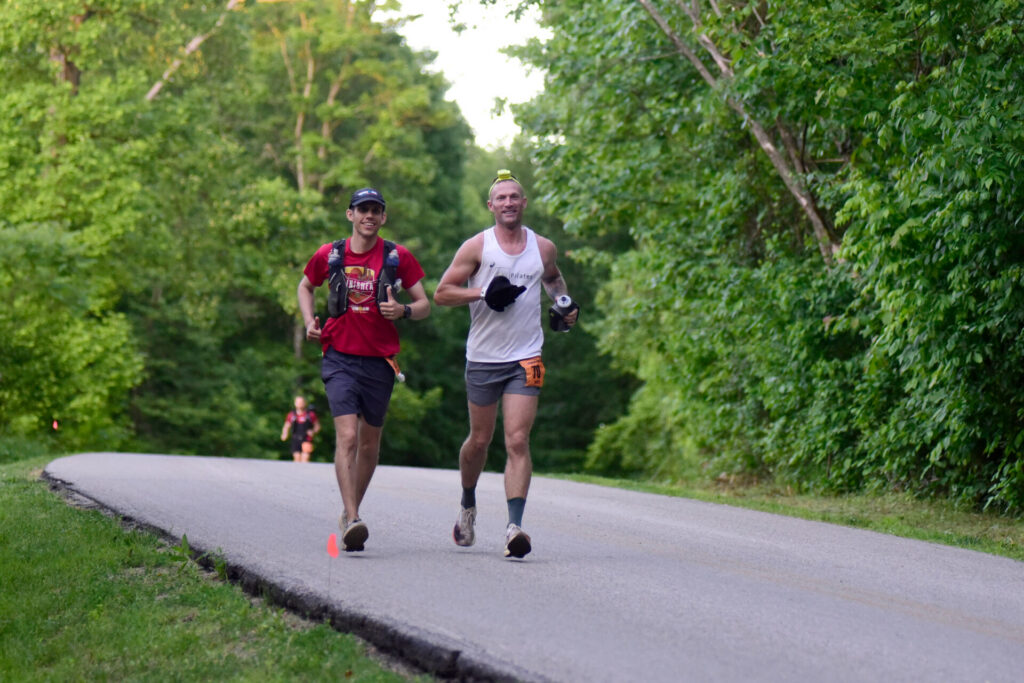
But ice bandanas, which hold ice against an athlete’s neck and shoulders, do more than feel good. Their main job is to lower a person’s core body temperature by cooling blood as it passes through the carotid artery.
“It’s one of those little things you can do,” Yoder said. “It’s not gonna gain you a lot of time, but it’s gonna keep your heart rate down a little bit and keep your effort level down.”
MORE: Justin O’Dell youngest to complete both Mohican races: bike and run
Cycling champion uses ‘nose breathing’ to stay cool
Dave Walker, a five-time winner of the Ohio Mountain Bike Championship Series, says he prefers regulating his body’s temperature without the help of ice packs.
“I find the shock of the cold is too much, even when spectators and family help by throwing water,” Walker said.
His personal approach is to “stay in the heat” and trust that his body adapted to handle the summer temperatures.
“The key is to only breathe through your nose,” Walker said.
The experienced rider said breathing through his nose is a conscious choice he makes at the start, on climbs, during sprints and while on the attack. No matter the situation, he finds the steady air intake through his nose to be helpful.
“It will help you to stay much cooler than mouth breathing and you won’t need as much water,” Walker said. “Nose breathing requires long, steady, deep breaths in and out, as opposed to shallow breaths that fill the upper portion of your lungs … it’s a method that opens the door to many performance benefits.”
MORE: Running the day after an ultra speeds recovery
‘The most important ingredient is water’
Endurance athletes have battled high temperatures since the beginning of sport.
Dr. George Sheehan once wrote about a friend who, after 14 miles, dropped out of the Boston Marathon and discovered they had lost 12 pounds, equivalent to about five quarts of sweat.
“He was fortunate not to have suffered an acute heat syndrome,” Sheehan wrote in This Running Life, a book that led Sports Illustrated to call the doctor-runner “our most important philosopher of sport.”
The only way to mitigate fluid loss is by drinking more, both before and during athletic activity.
“The most important ingredient is water,” Sheehan said. “Only secondarily should we worry about what is in it.”
Electrolytes are essential to human health, but not as critical as water itself.
“Water not only saves, you see, it also insures maximum performance,” Sheehan said. “Keeping your fluid level normal also keeps your blood volume normal. That is what allows you to run efficiently. Passing up the water not only sets you up for a heat stroke, it does something worse; it makes you run badly.”
MORE: West Virginia woman shares how she conquered Cocodona 250
The CDC offers the following precautions for athletes during extreme heat:
- Limit outdoor activity, especially during the middle of the day when the sun is hottest if possible.
- Wear and reapply sunscreen as indicated on the package.
- Schedule workouts and practices earlier or later in the day when the temperature is cooler.
- Pace activity. Start activities slow and pick up the pace gradually.
- Drink more water than usual, and don’t wait until you’re thirsty to drink more. Muscle cramping may be an early sign of heat-related illness.
- Monitor a teammate’s condition, and have someone do the same for you.
- Wear loose, lightweight, light-colored clothing.
Subscribe to Wilderness Weekly on YouTube at youtube.com/@WildernessTube.
Email Us: editor@wildernessweekly.com
